

Young beginners usually don't need ski poles. They can learn balance, gliding, stopping and turning with their hands free. Poles become useful later, when a child can manage them and is ready to learn how they fit into skiing.
Adding two poles doesn’t automatically make you a better skier. It does give your parent two more things to pick up.
“It’s skis that make you a skier, not poles! First-time little skiers won’t need poles.” — Mike Clelland, Ski Tips for Kids
Why leave poles behind at first?
A new skier is already managing unfamiliar boots, two sliding feet, a helmet, goggles and instructions delivered by an adult who may be more excited than helpful.
Poles add gripping, carrying, avoiding tangles and keeping the tips away from other people. They can also become a prop a child leans on instead of learning to balance over their feet.
With hands free, it's easier to practise a relaxed athletic stance, reach forward, get up with assistance and play the simple games that help a child look where they're going. It also makes handling beginner lifts less complicated.
That's a useful trade at the beginning: fewer objects, more attention for the skiing.
What should they learn without poles?
Start with standing and moving in boots, then walking and shuffling on skis on flat terrain. Move to short, gentle glides where the child can stop, and practise controlling speed with a wedge and turns.
Hands can stay comfortably forward without holding anything. If they drift behind the child or the child stares at their ski tips, use a simple visual cue or game. An instructor can suggest a game that suits the skill they are learning, rather than adding something else to carry.
Don't mistake the absence of poles for a missing skill. The child is still learning to stand on moving skis, which is a substantial job all by itself.
When are kids ready for poles?
The book places pole introduction later in the progression, around more challenging blue terrain. That's a useful reminder to avoid rushing; it isn't a universal rule based on the colour of the next run.
Look at the child rather than the birthday or trail sign. Can they stop and turn reliably on their current terrain? Can they keep a stable stance and look ahead? Can they manage lifts and carry their equipment without poles becoming a distraction? Are they ready to follow instructions about pole tips, baskets and straps?
An instructor can help choose the timing and introduce poles as part of a lesson. A child may be ready before or after another child of the same age.
The fact that their friend has poles is persuasive evidence to the child. It is less persuasive evidence about skiing readiness.
Choosing a suitable pole

Use poles sized for the child, with grips they can hold comfortably in their usual mittens or gloves. A shop or instructor can check length and demonstrate how to hold them. Don't assume that shorter adult poles are automatically the best answer for very small hands.
Make sure the child understands which end belongs near the snow and where the basket and tip are. Explain and demonstrate strap use according to the product and instructor's guidance. Pole management around lifts and terrain needs its own attention.
There is no prize for buying a long pair to last several growth spurts. Equipment that is awkward today remains awkward even if it was good value.
Introduce one job at a time

Begin somewhere easy. Practise holding and carrying the poles, then moving with them without waving the tips around. Let the child make familiar turns with their hands still comfortably forward.
Later, an instructor can introduce pole-touch timing and how it supports the rhythm of turns. Avoid adding a pole-plant lecture while also introducing harder terrain and asking for parallel turns for the first time.
If the poles distract from previously reliable skiing, step back. They can stay in the rack while the child reconnects with balance and turn shape. That's an adjustment to the lesson, not a demotion.
If the poles start doing the skiing

The book calls leaning on the poles like crutches “spidering.” Watch whether your child is still balancing over their feet, or has started propping themselves up with their hands. If the poles are keeping them upright, leave them behind for a few easier runs and work on balance.
“If it’s more fun skiing without poles, then just ski without ’em. Fun is more important than poles!” — Mike Clelland, Ski Tips for Kids
Keep the hands relaxed and comfortably forward. Pole touches should be light; there is no need to excavate the slope. Mike’s imaginary sleeping polar bears are a cue for a gentle tap, not an invitation to investigate the local wildlife.
Poles and lifts
Have a plan for carrying poles through the line, loading and unloading. Follow the ski area's instructions and ask the attendant if you need help. Small children may need hands available for other parts of the process.
Our Chairlift Guide covers preparation, loading, riding and unloading. Take pole straps off your wrists before loading and follow staff instructions for carrying the poles. Introduce poles to that routine deliberately, rather than discovering their complications when the chair is already approaching.
When in doubt, keep it simple
For a first-time little skier, leave the poles behind and concentrate on balance, speed control and enjoyable practice. Add them when they have a job to do and the child is ready to learn that job.
Your child will still look like a skier. The skis are a fairly convincing clue.
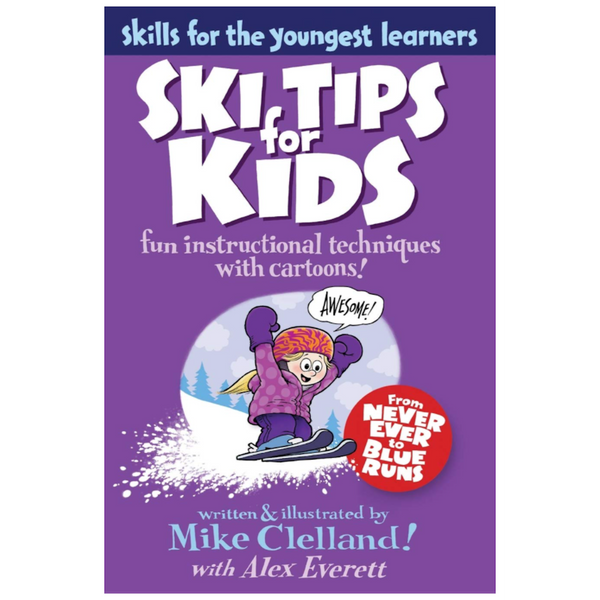
Illustrations by Mike Clelland, from Ski Tips for Kids.
More Ski Tips for Kids
Pass on Poles (For Now) · How to Ride a Chairlift With Kids · Kids’ Ski Gear Guide · Best Tools for Teaching Kids to Ski


